Upload2Shell (CVE-2026-125396) is a Ghostscript -dSAFER bypass in .putgstringcopy, and the fix has been public since September 8, 2026. The CVE only appeared on November 10. If you patched WordPress or Roundcube and stopped there, you closed one door into Ghostscript and left the others open. I read both Artifex commits, the WordPress changeset and every distribution tracker I could reach. Five things stood out that I have not seen written up elsewhere:
- Ghostscript 10.08.0 ships only the first fix. The C rewrite that removes
.forceputfrom this code path (commit e0421767) is not in the 10.08.0 tag. The released fix is a type check in front of the same.forceputcall. - WordPress 7.0.4 still hands any file that starts with
%PDF-to Imagick, and Imagick hands it to Ghostscript. The CNA says a crafted PDF can trigger this bug. - If you applied Red Hat’s RHSA-2026:83551 for the two sibling Ghostscript CVEs last month, you are most likely still exposed to this one.
- The CNA score says local attack vector. The researcher’s own paths are an HTTP upload, an email attachment and an anonymous IPP print job.
CVE-2026-125396 Ghostscript
- CVSS v4 8.5, scored local, reachable over HTTP, SMTP and IPP
- Public PoCs since November 22
- EPSS 0.0013 to 0.0035 on November 22
- Not in CISA KEV 2026.11.20, SSVC exploitation none
Patch to 10.08.0 or distribution build
Patch Ghostscript and verify by package version, not gs --version.
Root cause
CVE-2026-65640 WordPress Core
- Needs upload_files, Author role or higher
- Real PDF files still reach Ghostscript after the fix
7.0.4 or branch backport
Closes disguised PostScript, not the PDF path.
Entry point
CVE-2026-114727 Roundcube
- Attachment content passed to ImageMagick on resize
1.6.20 or 1.7.5
Patch Roundcube and Ghostscript together.
Entry point
Upload2Shell (CVE-2026-125396): Root Cause
The bug is in .putgstringcopy, a ten-line PostScript procedure in Resource/Init/gs_fonts.ps that the font loader uses to store a string into a dictionary. This is the pre-fix code, the same lines the CVE record links at the ghostpdl-10.07.0 tag:
/.putgstringcopy  %   <dict> <name> <string> .putgstringcopy -
{ 2 index gcheck currentglobal
  2 copy eq {
    pop pop .forceput
  } executeonly {
    5 1 roll setglobal
    dup length string copy
    .forceput setglobal
  } executeonly ifelse
} .forcebind odef % must be bound and hidden for .forceput
Nothing checks the operand types. If length or copy fails on the wrong type, execution stops with the privileged .forceput next in line and the allocation mode still switched. That is my reading of the code. It fits the CNA text: a custom error handler recovers .forceput, and a use-after-free across save and restore follows. Artifex’s bug title says the result is native read and write and controlled dispatch.
The fix in 10.08.0 adds one type check in front of the same .forceput call. I confirmed this by dumping the compiled init code out of my 10.07.0 and 10.08.0 builds. Artifex also wrote a C replacement with no .forceput (commit e0421767), but it is not in the 10.08.0 release.
Upload2Shell (CVE-2026-125396): Reachability Analysis
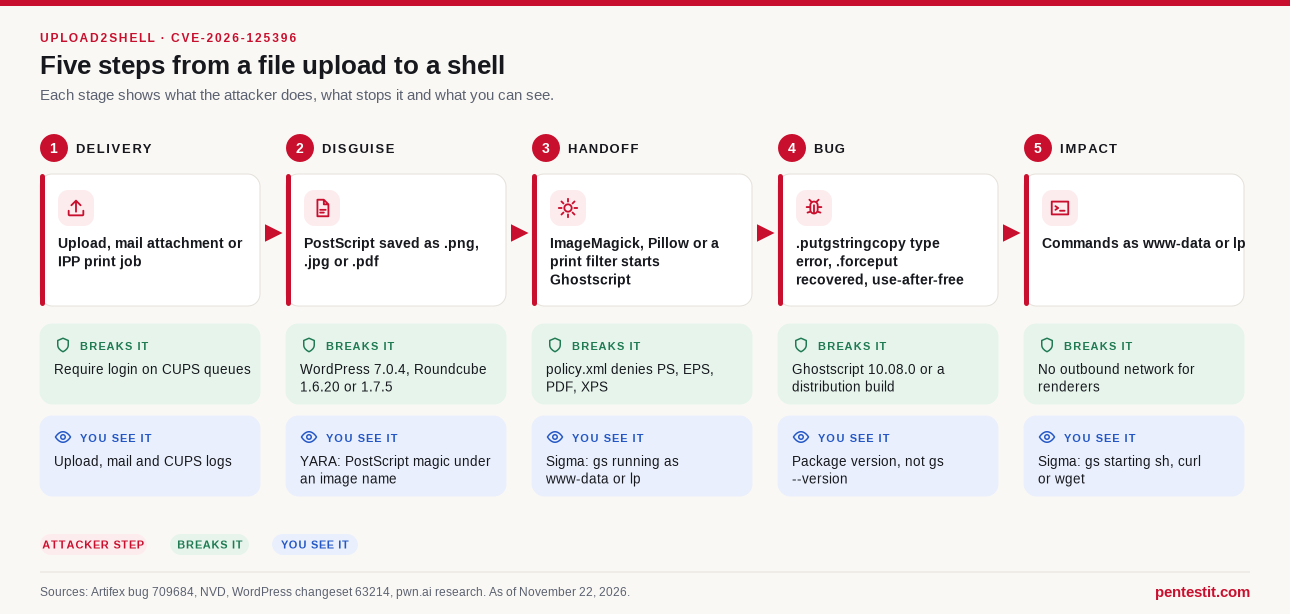
The CNA scored this as a local attack. Nobody opens these files by hand on a server: a thumbnailer, a mail preview or a print filter does it on arrival. The researcher confirmed these paths:
| Entry point | What the attacker needs | Ghostscript runs as | Application fix version |
|---|---|---|---|
| WordPress media upload | An account with upload_files (Author or higher) | Web server user | 7.0.4 and backports to 4.7.35 |
| Roundcube attachment preview | A mail the user opens | www-data | 1.6.20, 1.7.5 |
| CUPS shared queue on Debian 13 | Network reach to IPP, no login | lp | None; only Ghostscript fixes it |
The same research reached Ghostscript through public upload widgets in Forminator and Essential Addons for Elementor, MediaWiki PdfHandler, DokuWiki, Mayan EDMS, ResourceSpace, Plesk’s Roundcube and a Google production renderer (fixed by Google on November 10). The trick is old: the application trusts the extension, ImageMagick trusts the first bytes, so holiday.png that starts with %! is rendered as PostScript.
WordPress 7.0.4 (changeset 63214) now refuses Imagick format prefixes such as PS:, PostScript-family extensions, PostScript, EPS and WPG magic bytes, and compressed files. It still loads any file that starts with %PDF-, through Imagick’s PDF coder, which uses Ghostscript. The CNA says a crafted PDF can trigger the bug. I have not seen that shown for Ghostscript 10.x, so treat an unpatched Ghostscript behind WordPress 7.0.4 as reachable by anyone who can upload a PDF.
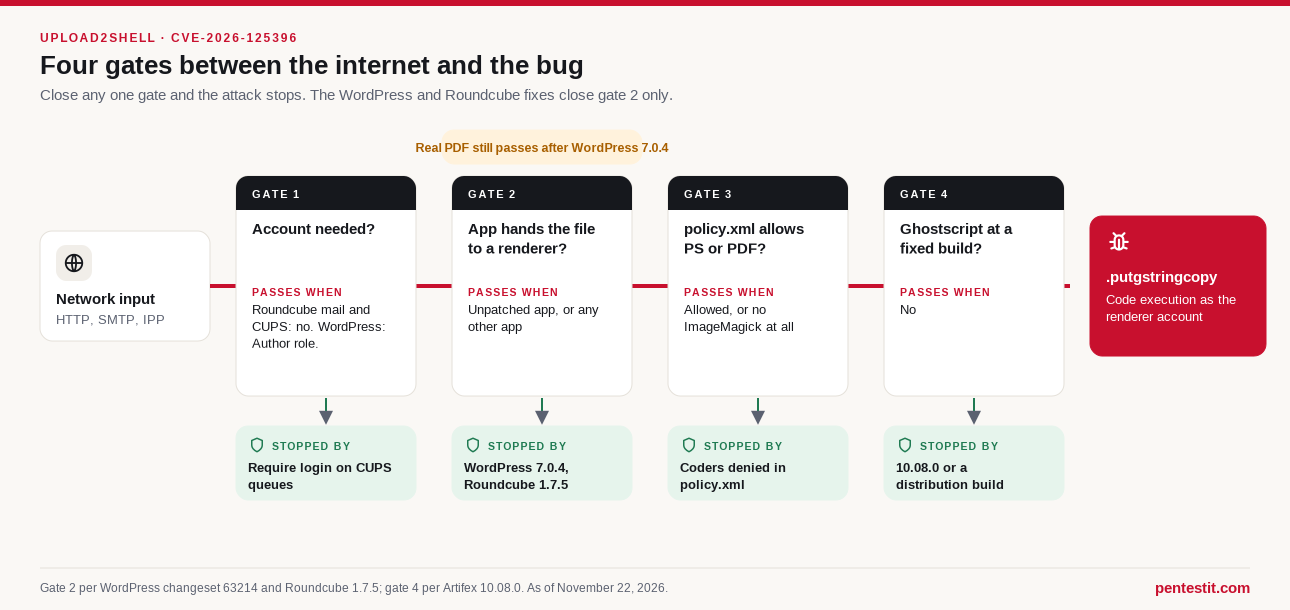
In-process renderers (Pillow, libvips, Qt plugins) never start a gs process, so process-based detection does not see them.
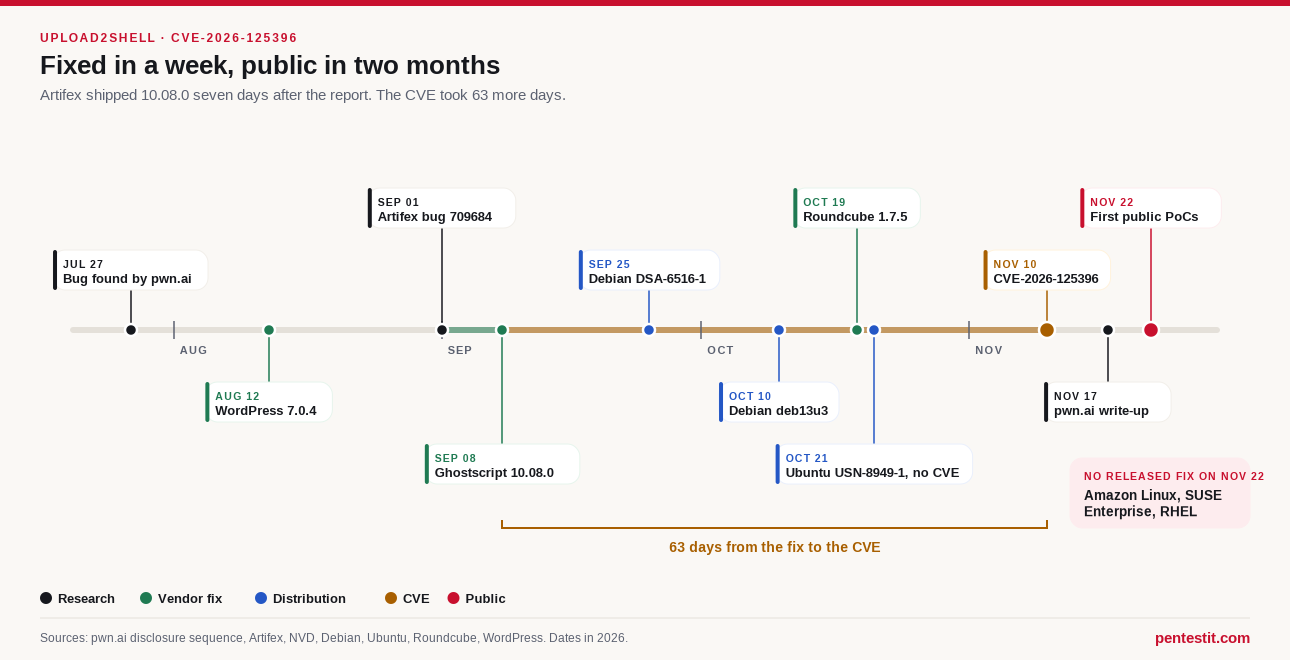
Timeline: CVE-2026-125396 was assigned 63 days after the fix
The researcher found the bug on July 27 and told WordPress first, which is why WordPress shipped its fix 20 days before Artifex had a bug report. Artifex then took seven days from report to release. Everything after that was slow, and three vendors still had no released fix on November 22.
Days from the Ghostscript 10.08.0 release
Am I patched? Affected versions and the caveats
Status read from each vendor page on November 22, 2026. The last column is where “we already patched Ghostscript” goes wrong.
| Platform | Fixed build | Caveats |
|---|---|---|
| Ghostscript upstream | 10.08.0 | Everything before 10.08.0 is affected |
| Debian 13 trixie | 10.05.1~dfsg-1+deb13u3 | Still reports 10.05.1. The tracker also lists deb13u2 (DSA-6516-1); the researcher calls u3 the current fixed build |
| Debian 12 bookworm | 10.0.0~dfsg-11+deb12u9 (DLA-4914-1) | deb12u8 is vulnerable |
| Debian forky, sid | 10.08.0~dfsg-2 | |
| Ubuntu 16.04 to 26.10 | USN-8949-1 builds (16.04 to 20.04 through Ubuntu Pro) | Still report the old version, and Ubuntu’s CVE page still says Needs evaluation for every release |
| RHEL 10 | None for this CVE | RHSA-2026:83551 (10.02.1-16.el10_2.3) covers two sibling CVEs, not this one. Red Hat’s bug has no fixed version and the CVE page does not load |
| Fedora | None for this CVE yet | The October 16 update (10.05.0-7) names CVE-2026-39919 and CVE-2026-101258 only |
| openSUSE Tumbleweed | 10.08.0-5.1 | |
| SUSE Enterprise 12 SP5, 15 SP4 to SP7, 16 | In QA or in progress | No released update |
| Amazon Linux 2, 2023, 2027 Preview | Pending | No released update |
| WordPress | 7.0.4, 6.9.7 and every branch down to 4.7.35 | Real PDFs still reach Ghostscript |
| Roundcube | 1.6.20, 1.7.5 |
Container images, appliances and anything that bundles its own libgs carry their own version, which this table cannot show.
Public PoCs, and which checker you can trust
On November 22, 2026 I counted six GitHub repositories with the CVE or the nickname in their name, description or topics, plus two more that cover it inside a larger project. Every one is original work: no copied files, and no shared code beyond boilerplate.
| PoC Type | Repository | Safety status |
|---|---|---|
| Exploit-side (PoC lab, payload generator, fuzzer) | 3 | Clear: no prebuilt binaries, no decode-and-run, no hard-coded callback hosts. Not scored, by design |
| Version checkers | 3 | Clear; lab-tested |
| Impact write-up | 1 | Clear |
| Detection hunt (KQL, CrowdStrike CQL) | 1 | Clear |
The researcher’s own write-up also links a proof-of-concept PDF that demonstrates memory control without running commands.
I built four Ghostscript targets and ran every version checker against each, as an unprivileged user with no network: vulnerable 10.07.0, patched 10.08.0, patched with the version hidden, and back-patched (10.07.0 source with the 10.08.0 fix, still reporting 10.07.0, which is what a Debian or Ubuntu backport looks like).
| Target (truth) | Mahgal/upload2shell-check | ashrafzaryouh/CVE-2026-125396 | tearbu/daily-vuln-lab |
|---|---|---|---|
| 10.07.0 (vulnerable) | Vulnerable | Vulnerable | Vulnerable |
| 10.08.0 (fixed) | Patched | Safe | Patched |
| Version hidden (fixed) | Unknown, exit code 0 | Cannot parse, exit code 2 | Unknown, exit code 1 |
| Back-patched (fixed) | Vulnerable | Vulnerable | Vulnerable, with a backport warning |
Three findings from the lab:
- No public checker can tell a backport from a vulnerable build: They all read
gs --version. On Debian and Ubuntu that means every patched host is reported vulnerable. Check the package version against the tracker instead. - Mahgal’s exposure check misses ImageMagick 6: Its parser splits delegate lines at
=>, and ImageMagick 6 writes them aseps<=>pdf, so on stock Debian or Ubuntu it never reports the ImageMagick path into Ghostscript, the feature its README leads with. - Exit codes matter in CI: With the version hidden, Mahgal exits 0, so a pipeline treats an unknown host as clean.
Reliability scores use my published method (content 50, provenance 30, hygiene 20, content cap), compared within a class only. Owner account age, organization and commit signatures cannot be collected from my environment, so they are left out and the coverage is shown in the CSV.
Upload2Shell repository reliability scores
How hard is it to exploit Upload2Shell (CVE-2026-125396)?
One crafted document, no traffic volume, no race and no heap grooming in the public sources. The researcher reproduced it on Ghostscript 9.54.0, 10.05.1 and 10.07.0. The gate in front of Ghostscript decides who can use it:
Shared CUPS queue
- Network reach to IPP only
Mass scanning
Runs as lp. Fix this first if it exists on your network.
No login
Roundcube
- The user opens the message
Targeted phishing
Runs as www-data.
A mail
WordPress
- upload_files, or a plugin with a public upload field
Account needed
Runs as the web server user. Root needs a second bug.
Author role
Exploitation is not reported. CVE-2026-125396 is not in CISA KEV (catalog 2026.11.20, 1,790 entries), and CISA’s SSVC entry says exploitation none. The same catalog lists older bugs of this class, Ghostscript CVE-2017-8291 and ImageMagick CVE-2016-3714.
Detection
No request-level exploit detail is public, so the content rules look for the file-type mismatch and the two operator names in the CNA text, and the process rules hunt for what happens after. The full rules (YARA, Sigma, Zeek) are in my Sigma repository.
| Stage | What to look for | Where | Tested |
|---|---|---|---|
| Delivery | PostScript, EPS or WPG magic bytes in a file named like an image or PDF | Upload and mail temp directories (YARA) | Yes, benign samples |
| Delivery | Clear-text .forceput or .putgstringcopy in an uploaded file | YARA | Yes, benign samples |
| Delivery | application/postscript posted under an image name, or a PS: prefix in the file name | Zeek | No |
| Trigger | gs running as www-data, apache, nginx or lp | Process creation (Sigma) | Converts cleanly |
| After | gs starting sh, curl or wget | Process creation, Sysmon for Linux (Sigma) | Converts cleanly |
Read-only host triage. Judge the package version, not gs --version:
dpkg-query -W ghostscript libgs10 2>/dev/null; rpm -q ghostscript 2>/dev/null
find / -xdev \( -name 'libgs.so*' -o -name gs \) -type f 2>/dev/null
convert -list policy 2>/dev/null | grep -iE 'PS|PDF|EPS|XPS'
find /var/www -path '*uploads*' -type f \( -iname '*.png' -o -iname '*.jp*g' -o -iname '*.pdf' \) -print0 | xargs -0 file --mime-type | grep -i postscript
ps -eo pid,ppid,user,etime,cmd --forest | grep -B2 -A3 -E '[g]s |[m]agick|[c]onvert'
These miss compressed or obfuscated PostScript, files the thumbnailer already deleted, and in-process rendering.
What to do, in order
| Order | Action | Operational impact |
|---|---|---|
| 1 | Copy upload and mail temp directories, /var/log/cups and web logs before you change anything | Low |
| 2 | Patch Ghostscript everywhere, including container images and bundled libgs, then restart PHP-FPM, CUPS and queue workers | Medium |
| 3 | Patch WordPress and Roundcube | Low |
| 4 | No fix yet (Amazon Linux, SUSE Enterprise, RHEL): deny PS, EPS, PDF and XPS in ImageMagick policy.xml, require login on CUPS queues, block outbound traffic from renderers | High: PDF thumbnails and print-to-PDF stop |
| 5 | After patching, rotate WordPress salts and end Roundcube sessions | Medium |
| 6 | If gs started a shell: rebuild the host and rotate database credentials and wp-config.php secrets | High |
This is my advice and does not come from a vendor. None of the three vendors lists a workaround. Check the coder names your build exposes with magick -list format first:
<policy domain="coder" rights="none" pattern="{PS,PS2,PS3,EPS,EPI,EPSF,EPSI,EPT,PDF,XPS}" />
<policy domain="delegate" rights="none" pattern="*"/>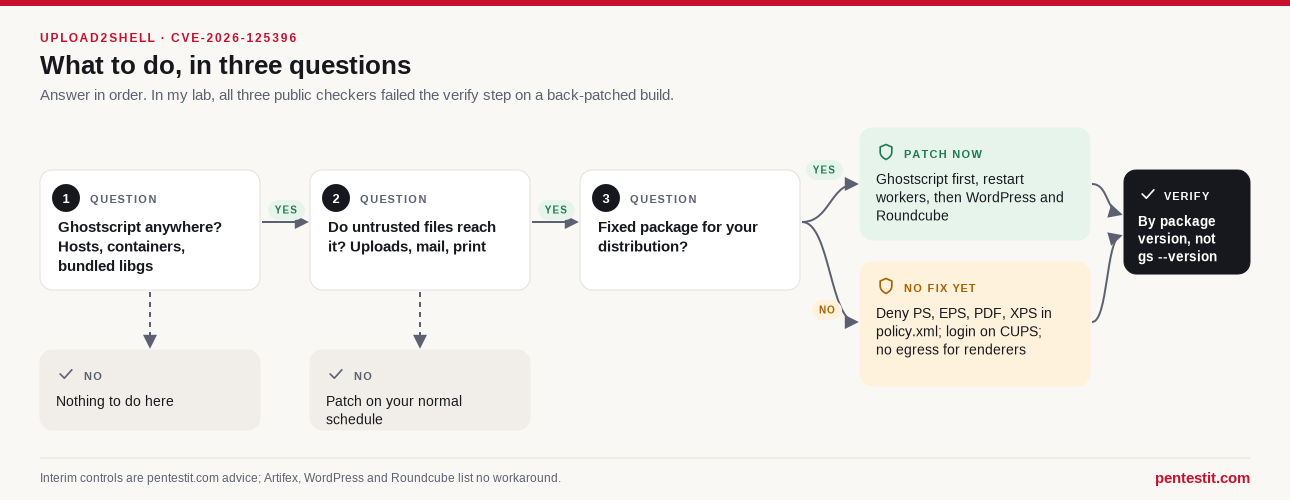
Leave a Reply
You must be logged in to post a comment.