NoisyTCP (CVE-2026-99288) is a race condition in the Linux kernel TCP lookup functionality that lets an unauthenticated threat actor who can reach a TCP port to crash the host. The fix is two commits and stable kernels 6.12.117, 6.18.63 and 7.3.4 carry only the first. Kernels 6.12.118, 6.18.64 and 7.3.5 (tagged 17 November 2026) carry both. The latest 5.10, 5.15, 6.1 and 6.6 releases carry neither. Your distribution package may still be fixed through a backport, so check its changelog, not the version number. I read the fix commits and the stable release tags straight from git, rechecked every vendor tracker on November 23, and ran every public NoisyTCP checker in a lab. These are some of my findings:
- The changelog check that most guides recommend, searches for the CVE ID. A fixed kernel whose changelog names only the commit subject reads as vulnerable.
- The kernel CVE team confirmed the precondition. Its November 19 score explanation says the attacker overflows the listener’s SYN queue so the default tcp_syncookies=1 path runs. That makes the SYN flood a visible precursor.
- One CVE, two commits. Stable kernels shipped the first commit on November 10 and the memory-ordering commit only on November 17. That matters on arm64.
- The 5.10, 5.15, 6.1 and 6.6 long-term branches have no upstream fix. Debian and Amazon backported it anyway, so the version string misleads in both directions.
- Multiple repositories deliver a NoisyTCP checker that scores the vendor mitigation as a vulnerability. It never looks at the kernel.

CVE-2026-99288, Linux kernel TCP established lookup race
- Attack vector: network, any reachable TCP listener, no privileges
- Container hosts: one panic takes down every container on the host
- Needs two or more RX queues, or RPS across CPUs
- Race window: 5 seconds to 2 minutes on QEMU/KVM guests, about 14 hours on quiet bare metal
- Exploitation: none known (CISA-ADP SSVC, 17 Nov); not in CISA KEV 2026.11.20
- Code execution: not shown; the researcher says not yet
Patch and reboot
Fix: commits 4e2b3ef19e0e and 5b5d8f351dd9
Both in stable: 6.12.118, 6.18.64, 7.3.5
No upstream fix: 5.10, 5.15, 6.1, 6.6
Remote crash, no login
NoisyTCP CVE-2026-99288: Root cause
The lookup that matches every incoming TCP packet to its connection takes no lock, and the memory behind a socket can be handed to a new socket while an old reader still holds its address. __inet_lookup_established() and its IPv6 twin find a matching socket, take a reference and check the address and ports again. They never check whether the object is still in the hash table. If another CPU frees a request socket and the same slab slot is reused for a new SYN cookie request with the same four-tuple, the stale lookup returns the new object. That request has no listener. tcp_v4_rcv() reads the socket state through a NULL pointer at offset 0x12 and the kernel panics in interrupt context.
The fix, 4e2b3ef19e0e, adds the missing hashed check and makes the SYN cookie, Fast Open and request migration error paths release references with reqsk_put(). The second commit, 5b5d8f351dd9, restores the memory ordering that an earlier refcount rework (fb041bb7c0a9) removed on weakly ordered CPUs. Its own message says what was lost; that the first commit alone leaves arm64 exposed is KernelScan’s reading, and I have not tested it on hardware.
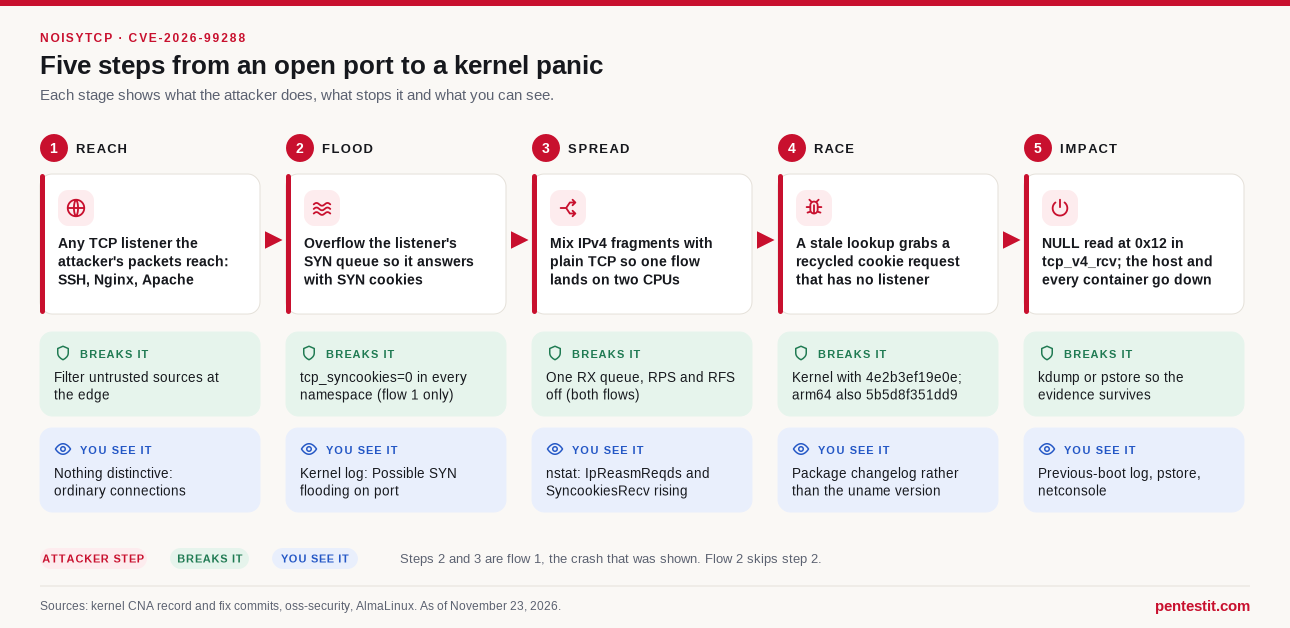
How a packet reaches the vulnerability
Five conditions sit between the attacker and the vulnerable lookup. Close any one and the attack stops; only the patched kernel removes the bug.
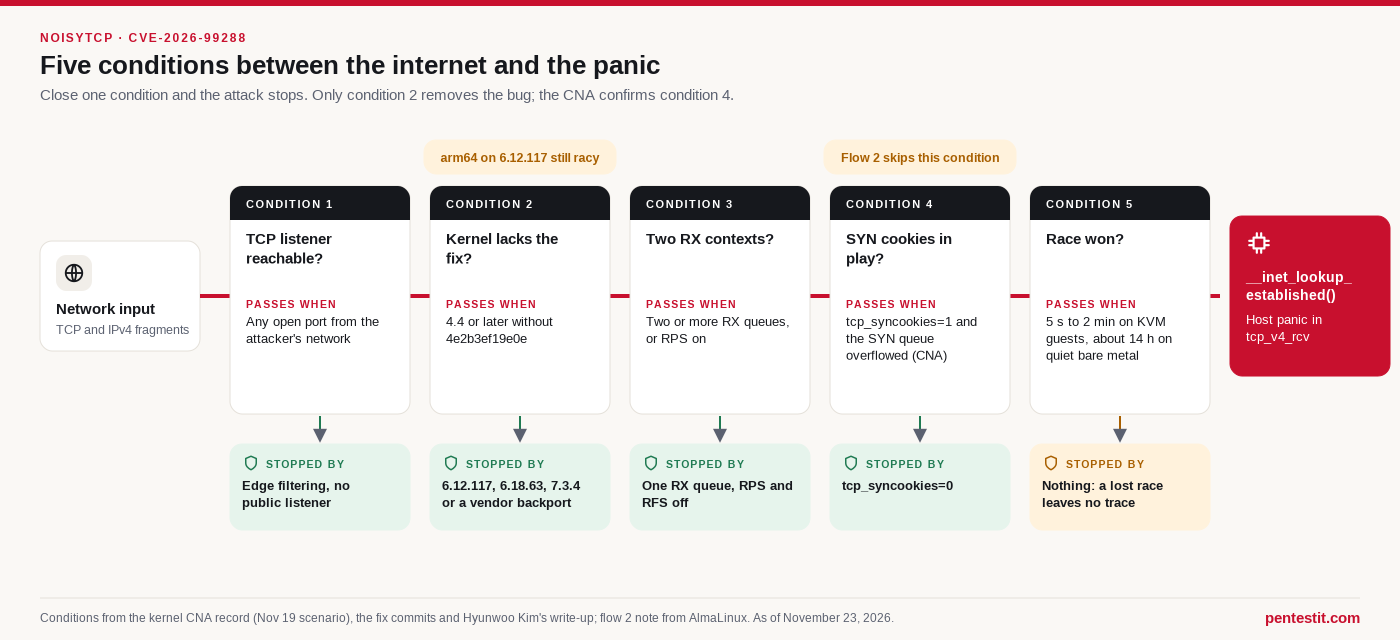
The kernel CVE team’s scoring note says the attacker “overflows the listener SYN queue so default tcp_syncookies=1 enters cookie_v4_check” which is what I had deduced as well.
NoisyTCP CVE-2026-99288: Timeline
The vulnerability has been in the kernel since October 3, 2015. The fix was readable on a public mailing list from October 29, 17 days before the researcher’s write-up, so anyone diffing networking patches had it early.
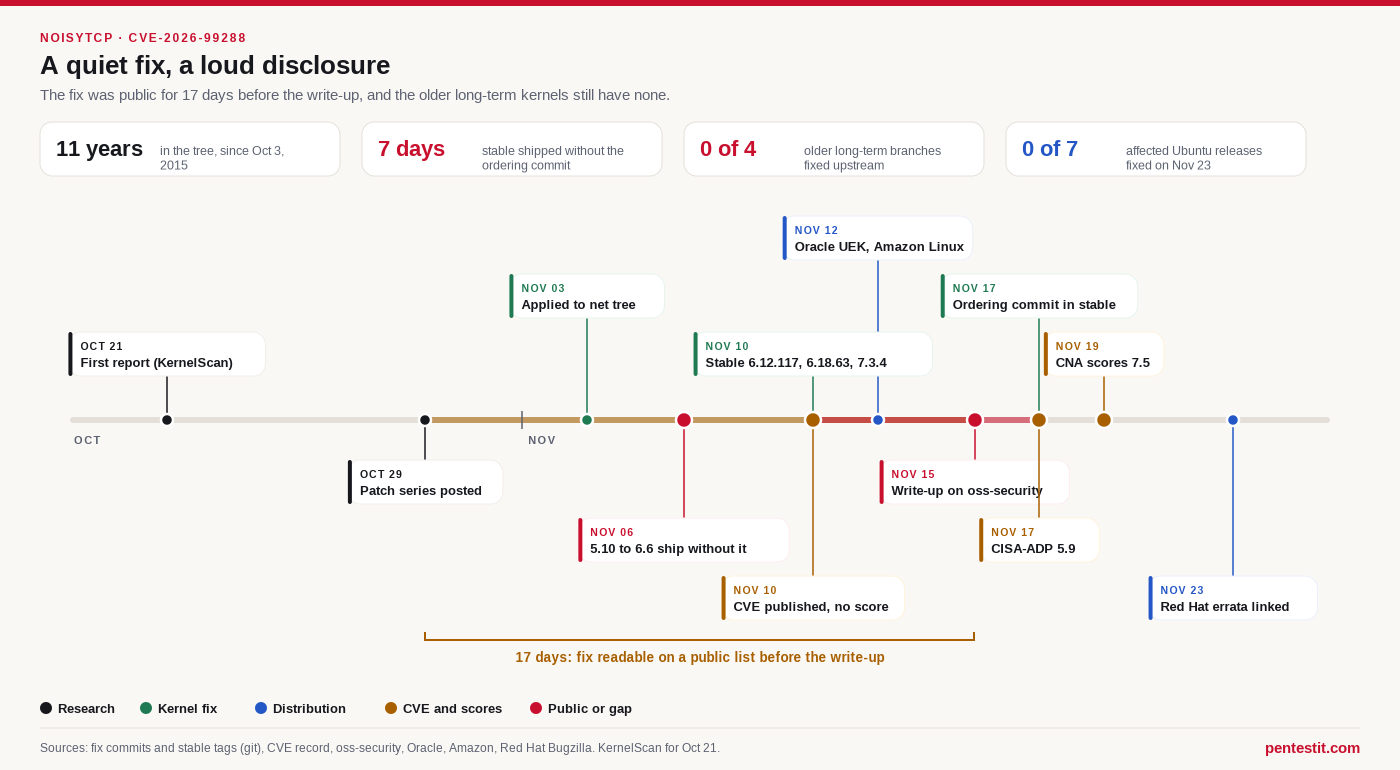
Days after the fix reached the networking tree (November 3)
Who has a fix, and the caveats
As of November 23, 2026, rechecked live on every tracker listed.
| Kernel source | Fixed build | Caveats |
|---|---|---|
| kernel.org 6.12, 6.18, 7.3 | 6.12.118, 6.18.64, 7.3.5 (both commits) | 6.12.117, 6.18.63 and 7.3.4 carry the first commit only, which closes the shown crash on x86; on arm64, take the ordering commit too |
| kernel.org 5.10, 5.15, 6.1, 6.6 | None. Latest 5.10.274, 5.15.225, 6.1.192, 6.6.162 carry neither commit | Appliance and self-built kernels on these branches stay exposed |
| kernel.org 7.2 | None; the branch ended at 7.2.15 | Move to 7.3.5 or later |
| Debian | trixie 6.12.117-1 (DSA-6628-1), now 6.12.118-1; bookworm 6.1.192-1 (DLA-4906-1) and linux-6.12 6.12.117-1~deb12u1 (DLA-4927-1); forky and sid 7.3.5-1 | Bookworm’s 6.1.192 is a Debian backport. Upstream 6.1.192 is not fixed |
| Ubuntu 16.04 to 26.10 | None. Vulnerable on every release, priority raised to High | The page shows the CISA-ADP 5.9 score next to a High priority |
| Red Hat RHEL 8, 9, 10 | RHSA-2026:102167 and RHSA-2026:102168 linked to the bug on November 23 | I could not read either erratum, and the bug is still NEW with no fixed-in version. Confirm the product and package first |
| AlmaLinux 8, 9, 10 | Testing repository only: 4.18.0-553.186.2.el8_10, 5.14.0-741.22.2.el9_9, 6.12.0-264.16.2.el10_3 | AlmaLinux adapted the fix by hand for the 4.18 kernel |
| Oracle Linux UEK | ELSA-2026-500630, -500631, -500632 (November 12 and 13) | ELSA-2026-500630 is the only advisory I found that names both commits |
| Amazon Linux 2 and 2023 | Every kernel fixed between November 12 and 17 (ALAS2-2026-4124, ALAS2023-2026-3455, -3448, -3477) | Amazon fixed its 5.4 kernel too, a branch upstream no longer maintains |
| SUSE, openSUSE | Unknown | SUSE’s page for this CVE could not be read |
How hard is it to exploit?
Easy to aim, slow to land on quiet hardware, and it only crashes. Cloud guests are the soft target.
Flow 1: SYN cookie request reuse
- Access: one reachable TCP port, no account
- Time on QEMU/KVM guests: 5 seconds to 2 minutes (researcher)
- Traffic: a SYN flood to push the listener into cookie mode, plus fragmented and plain TCP aimed at two CPUs
- Time on quiet bare metal with 8 RX queues: about 14 hours, with a PoC tuned to that host
- Gain: a crash. No memory disclosure, no code execution
Practical against VMs
Cheap to try against cloud fleets. Noisy enough to see.
Mass denial of service
Flow 2: full child socket use-after-free
- Needs nested races to succeed; the researcher calls it hard without special techniques
- No public crash, no public exploit
Not shown
Watch, do not plan around it.
Targeted at most
NoisyTCP CVE-2026-99288 Public PoCs Tested
On November 23, GitHub had 19 repositories naming NoisyTCP or the CVE in their name or description (5 with the CVE ID, 14 with the nickname only). I scored them with my PoC repository reliability method: exploit-side repositories get a safety status only, defensive ones get a score compared within their class.
- Five exploit-side repositories (crash PoCs and labs from re4, mustafasaydam, nsvk13, h0rn3t and nybikyt) are clear: no prebuilt binaries, no download-into-shell, no hidden decode-and-run, and none copies another. I did not run them.
- The researcher’s own repository holds only the write-up. His exploit is unreleased.
- Eleven repositories appeared within 18 minutes on November 23, each with the same checker. It expects tcp_syncookies=1, marks 0 as “VULNERAVEL”, and never reads the kernel version. Every page loads Google Tag Manager and ends in a WhatsApp sales link. Safety status: caution.
I built six lab targets in throwaway namespaces with no network: fake kernel versions, Debian changelogs, two RX queues and the real sysctl. Then I ran each checker as an unprivileged user.
| Target | donxud playbook | tal7aouy | TAVARDT |
|---|---|---|---|
| 6.12.110, unfixed | UNKNOWN | INDETERMINATE, hint right | 50/100, unchanged |
| 6.12.118, fixed | UNKNOWN | INDETERMINATE, hint right | 50/100, unchanged |
| Debian 6.1, backport in changelog | FIXED | INDETERMINATE | 50/100, unchanged |
| Debian 6.1, no fix | EXPOSED | INDETERMINATE | 50/100, unchanged |
| Debian 6.1, no fix, tcp_syncookies=0 | MITIGATED | INDETERMINATE | 30/100, “VULNERAVEL” |
| arm64 6.12.117, first commit only | UNKNOWN | INDETERMINATE, says fixed | 50/100, unchanged |
PoC reliability scores, compared within class
None of the three can tell an arm64 6.12.117 kernel from a complete fix. donxud’s is the only one I would run, and it is never wrong, but it says UNKNOWN on any kernel without a package changelog.
Mitigate NoisyTCP CVE-2026-99288
If you cannot patch yet, pick one control and accept its cost:
| Mitigation | Blocks | Operational Impact |
|---|---|---|
| One RX queue (ethtool -L iface combined 1) with RPS and RFS off | Both flows | Throughput; lost on reboot; some NICs refuse it |
| sysctl -w net.ipv4.tcp_syncookies=0 in every network namespace | Flow 1 only | Weaker SYN flood protection |
Then verify by changelog, matching the commit subject as well as the CVE ID:
zgrep -cE 'CVE-2026-99288|reject unhashed sockets during established lookups' /usr/share/doc/linux-image-$(uname -r)/changelog.Debian.gz
rpm -q --changelog kernel-core-$(uname -r) | grep -cE 'CVE-2026-99288|reject unhashed sockets during established lookups'
On arm64, also look for “restore refcount ordering for lockless socket access”.
Detection
A lost race leaves nothing. A won race leaves a panic only if something kept it. The useful signal comes before the crash. None of these has been tested against a live trigger.
| Stage | What to watch | Rule |
|---|---|---|
| Flood | Kernel log “Possible SYN flooding on port”; TcpExtSyncookiesSent and SyncookiesRecv rising on a host that rarely sends cookies | donxud’s precursor rule |
| Spread | IPv4 fragments carrying TCP to a listener; IpReasmReqds rising | noisytcp_tcp_fragments.zeek in my Sigma repository |
| Impact | “BUG: kernel NULL pointer dereference, address: 0000000000000012” with “RIP: 0010:tcp_v4_rcv+”, kept by pstore, kdump, netconsole or the previous-boot journal | noisytcp_tcp_v4_rcv_null_deref.yml in my Sigma repository |
| Drift | Someone turns the mitigation back off | donxud’s mitigation drift rule |
My crash rule is narrower than donxud’s: it needs the 0x12 address and tcp_v4_rcv together. Match the function name, not the offset, which changes per build. Flow 2 has no published signature.
Frequently asked questions
Is NoisyTCP remote code execution?
No, not as of November 23, 2026. The demonstrated impact of CVE-2026-99288 is a kernel panic from a NULL pointer read. The researcher describes a second path to a use-after-free, calls it hard to trigger, and says code execution is not possible yet. No vendor claims code execution.
Which kernel versions fix CVE-2026-99288?
Upstream 6.12.118, 6.18.64 and 7.3.5 carry both fix commits. 6.12.117, 6.18.63 and 7.3.4 carry only the first, which closes the shown crash on x86. The 5.10, 5.15, 6.1 and 6.6 branches have no upstream fix, though Debian and Amazon backported it.
Am I safe if I disable SYN cookies?
You are safe from the demonstrated crash, which needs the SYN cookie path. The second flow does not use SYN cookies, so only a patched kernel or a single receive queue with RPS and RFS off covers both. The setting is per network namespace, so set it in every container.
Is CVE-2026-99288 exploited in the wild?
No exploitation is known. It is not in CISA KEV catalog 2026.11.20, and CISA-ADP rated SSVC exploitation as none on November 17. Five third-party crash PoC repositories are public on GitHub, so expect attempts against cloud virtual machines, where the race wins fastest.
Can a public NoisyTCP checker tell me if I am patched?
Not reliably. In my lab, none of the three public checkers could tell an arm64 kernel with only the first commit from a complete fix. Eleven TAVARDT copies even flag the vendor mitigation as a vulnerability. Check the package changelog for the commit subject instead.
Leave a Reply
You must be logged in to post a comment.