Most security teams eventually hit the same problem – the list of “detections to build next” grows faster than the capacity to actually build, test, and maintain them. Inputs from red-team exercises, threat intelligence reports, new CVEs, leadership asks, compliance requirements, and plain hype can drive a perfect prioritization backlog haywire.
Without a clear model for threat detection prioritization, engineers end up picking detections based on their gut feel or whatever seems loudest that week. This is a good way to burn time on low-value rules while real risks stay invisible in production.
To beat this problem, I recommend following a risk-based and context-aware prioritization for this reason. This prioritization can be spread across the following domains:
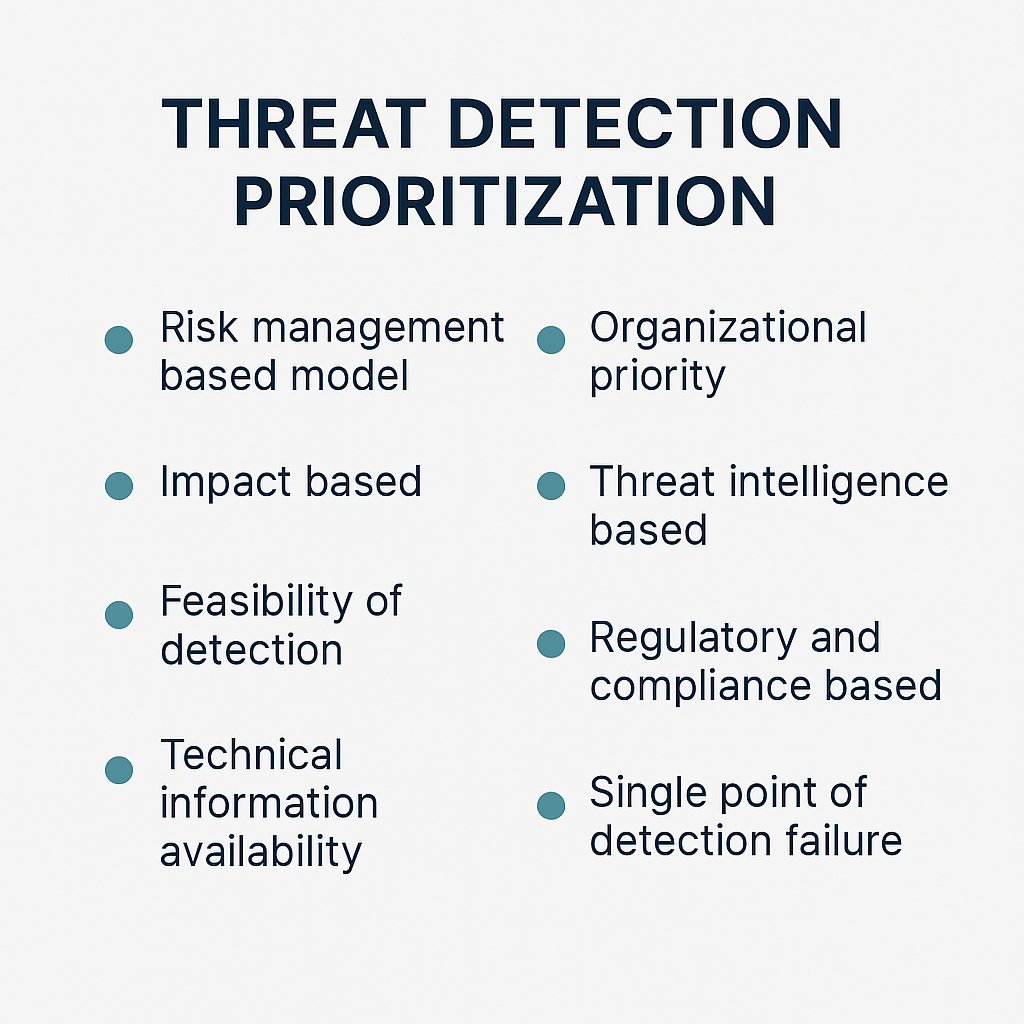
You can evaluate on these axes and then rank them based on your needs. The exact scoring scale does not matter as much as using it consistently.
The Risk Management Based Model:
Risk management is the backbone. Instead of asking “is this detection interesting?”, the better question is: “Which risks does it meaningfully reduce, and how big are they really?” Modern risk-based approaches rank items by combining likelihood and impact, then prioritizing the items in the “high impact / high likelihood” quadrant. This same logic works well in this case:
- Likelihood: How likely is it that this behavior or technique will be used against the environment, given current threats, architecture, and controls?
- Impact: If this behavior is not detected, what is the realistic worst-case business outcome?
Risk-based alerting and risk-driven SIEM use case development are already well-established practices; they are used to focus on a small subset of high-value detections rather than chasing every possible event. Aligning the detection backlog to the same risk model used in enterprise risk.
Practical takeaways: Every detection candidate should explicitly state which risk(s) it addresses and how it changes the risk score (for example – “this detection reduces likelihood of ransomware impact on crown-jewel systems from High to Medium”).
The Impact Based Prioritization Model:
Impact deserves its own special microscopic lens. Some detections might trigger rarely, but the blast radius if they are missed is catastrophic: domain-wide ransomware, payments fraud or regulatory reportable data breaches.
Industry risk models and guidance consistently treat impact as at least half of the prioritization equation. For detections, impact can be framed in business terms:
- Financial loss or revenue interruption
- Regulatory fines or legal exposure
- Brand and reputation damage
- Safety or mission-critical system disruption
When the backlog is large, high-impact detections that protect critical assets should be fast-tracked even if they are somewhat harder to build. This is aligned with guidance on risk-based prioritization in vulnerability management and alerting: focus first on the scenarios that can genuinely threaten business continuity, not just those with interesting telemetry.
Practical takeaway: Add an “Impact” field to each backlog item, mapped to business consequences rather than purely technical descriptions.
The Feasibility of Detection Model:
Not every high-risk behavior is equally detectable. Good backlog management acknowledges engineering reality that some ideas require months of work (new log sources, control changes, data normalization), while others can be built in a matter of a few days. Frameworks such as MITRE ATT&CK based detection prioritization explicitly combine attacker centric factors with visibility and data source feasibility before ranking techniques. That same pattern scales to any backlog:
- Data availability: Are the required events already collected, normalized, and retained?
- Signal quality: Can this behavior be described in a way that yields a low false positive rate across a large enterprise real estate?
- Implementation effort: How many systems, teams, or tools must be touched to make this detection effective?
- Operational overhead: Can the SOC realistically triage and respond to this alert?
Research on detection backlog prioritization emphasizes that the priority list should optimize both risk reduction and cost to implement, given finite engineering and SOC capacity.
Practical takeaways: Do not treat “high risk but nearly undetectable with current telemetry” as the same priority as “high risk and easily detectable tomorrow.” You can score feasibility separately, and consider fast wins as a way to improve coverage while larger engineering projects are in flight.
The Technical Information Availability Model:
Even when a malicious behavior is theoretically detectable, success depends on having enough technical detail to turn an idea into a robust detection. Evidence based threat prioritization models map threat actor tactics, techniques, and procedures (TTPs) onto available controls and data, then rank threats where there is sufficient detail to build and measure defenses. Detection engineering teams see the same pattern:
- High-quality technical write‑ups, PCAPs, YARA/Sigma examples, logs, and procedure chains make it much easier to craft precise rules.
- Vague “there is a new threat” alerts, with little operational detail, often result in brittle or noisy detections.
Inputs into the detection backlog should meet defined quality criteria such as sufficient operational detail and reproducible techniques before being prioritized highly. Otherwise, engineers will spend more time reverse‑engineering the input than building detections.
Practical takeaway: Introduce a minimum bar for technical detail. Backlog items that lack concrete TTPs, log field examples, or observable behavior patterns can be tagged as “research needed” and not compete directly with fully specified items.
The Organizational Priority Model:
Detection engineering must reflect the business, not only the attacker. Risk-based SIEM and use-case roadmaps explicitly draw business leadership into defining top security priorities and critical risks. Those same inputs should influence detection ordering. An organizational priority can include:
- Strategic initiatives (cloud migration, OT modernization, acquisitions).
- Public commitments (security promises made to customers, auditors, or regulators).
- Known sensitive partners, customers, or contracts.
- Board-level or C-suite “top three risks”.
Modern risk-based prioritization tools also emphasize aligning technical workflows including remediation, triage, detection building with business impact and governance drivers, not just raw severity scores.
Practical takeaway: If leadership has clearly named a risk as critical, detections that provide direct coverage for that risk should jump the queue, assuming feasibility is reasonable.
The Threat Intelligence Based Prioritization Model:
Threat intelligence is one of the strongest signals for what to detect first. Multiple frameworks and industry references recommend mapping external and internal threat intel to MITRE ATT&CK techniques, then prioritizing those techniques when building detections. Primarily, there are two primary forms:
- External threat intelligence: Campaigns, actor profiles, and sector-specific reports that describe the techniques actually used in the wild against similar organizations.
- Internal intelligence: Blocked phishing samples, blocked malware, red-team exercises, and incident postmortems that reveal how adversaries (or testers) attempted to move through the environment.
Evidence-based threat prioritization recommends combining observed threat actor TTPs with the organization’s detection capabilities to rank which threats matter most and where to invest detection effort. Detection engineering backlogs benefit from that same data:
- Techniques frequently used by relevant threat actors
- Techniques seen in recent incidents or near-misses
- Techniques that would significantly shorten the dwell time of the kinds of attacks already faced
Practical takeaway: Feed CTI and internal incident data directly into the backlog and explicitly tag items with the actors or campaigns they relate to. Techniques with both high attacker frequency and existing visibility deserve top priority.
The Regulatory and Compliance‑Driven Detection Model:
Some detections are not just “nice to have”; they are required by regulatory bodies and their frameworks. Continuous controls monitoring and compliance programs emphasize near real-time monitoring of certain control families specifically to satisfy regulatory expectations. Examples include:
- PCI DSS requirements for daily log review and detection of suspicious activity on payment cardholder systems.
- SEC cybersecurity disclosure expectations that implicitly require the ability to detect and evaluate material incidents quickly.
- FedRAMP, SOC 2, NIST CSF, and other frameworks that call for monitoring of access control, configuration changes, and security-relevant events.
In these cases, lack of detection is not just a security risk, it is a compliance and audit risk. Organizations use continuous controls monitoring to tie detections directly to specific regulatory controls so they can prove that monitoring is active and effective.
Practical takeaway: Tag backlog items that support explicit regulatory or framework obligations. Ensure that any gaps tied to high-impact controls (for example, privileged access anomalies in a regulated environment) are prioritized aggressively.
The Avoiding Single Points of Detection Failure Model:
Finally, it is dangerous to bet the security posture on a single, fragile detection source. Defense in depth, including overlapping detective controls, exist precisely to avoid single points of failure. Guidance on defense in depth stresses redundancy and elimination of single points of failure so that a failure in one control or tool does not result in a complete blind spot. In the context of detection engineering, this means:
- Having multiple, independent ways to spot key stages of an attack (for example, initial access, privilege escalation, lateral movement, data exfiltration).
- Ensuring those detections run across different data sources and, ideally, different technologies.
- Being aware of detections that represent the only coverage for a critical technique and raising their priority for hardening, testing, and backup coverage.
In short, if one detection fails, others should still be able to surface the attack. A detection backlog should therefore explicitly mark “single coverage” areas and invest in secondary coverage where the risk justifies it.
Practical takeaway: As part of backlog grooming, identify detections that are the only control for a high-impact behavior. Add backlog items for diversified or compensating detections and prioritize them higher than “nice to have” new ideas.
Leave a Reply
You must be logged in to post a comment.